
How to Safely Recover a Stuck Vehicle (Mud, Sand, and Snow)


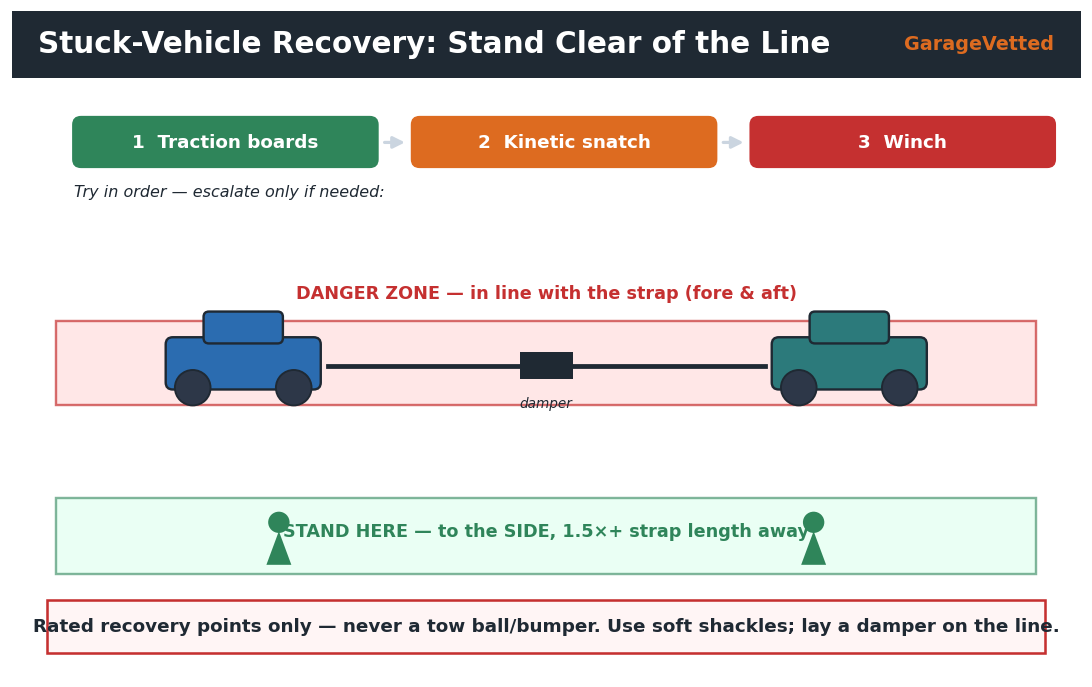
Getting a 4×4 stuck in mud is not the problem off road, recovering from it is. Thousands of pounds of force are needed to pull a bogged 4×4 out of the mud and the potential damage to the vehicle from the stored energy in recovery equipment is massive, not to mention the potential for serious injury to people using it. The biggest mistakes people make when recovering a stuck 4×4 is pulling hard on a chain with no adequate anchorage, tying a recovery strap around a tow ball and worst of all standing in the line of a loaded strap. In reality, most stuck 4×4’s can be recovered using basic recovery equipment if done in a calm and methodical manner.
Step-by-step: Recovering a Stuck Vehicle
- Stop and Assess: To recover a stuck vehicle efficiently and safely you first have to realize that you are stuck (this in itself can be difficult) then assess the reason for getting stuck in the first place (e.g. high-centered, one wheel buried, stuck in soft sand) and set up a safe recovery area. This safe recovery area should be such that all parties are on the same side of the stuck vehicle as well as the recovered vehicle at a minimum distance of 1.5 times the length of the strap being used. Also pay attention to the direction of pull and keep all parties out of the pull arc.
- Establish traction. Clear an area around the tire(s) and inflate the tire(s) to their recommended pressure (for hard surfaces) or deflate the tire(s) (for sand). Place your traction boards in front of the drive tire(s) and slowly drive forward in a straight line. In most cases you will not need to go any further and have little risk of making things worse.
- Step up to a kinetic (snatch) recovery only if needed. A kinetic rope stretches up to ~30% and “snatches” the stuck vehicle free with stored energy — a smaller vehicle can pull out a much heavier one. Connect only to rated recovery points on both vehicles.
- Rig it right. Recovery straps should be attached to the vehicle’s recovery points using soft shackles. Never attach to tow balls, bumpers, hitch pins etc. Also never tie two straps together with a metal shackle. Lay a recovery damper (or even a large blanket) over the middle of the strap to deprive it of energy if it does happen to snap.
- Pull smoothly – The recovery vehicle is taking up the slack in the rope and then slowly accelerating to take up the rope’s stretch. Two or three slow attempts at recovery will not be enough, you then need to go to a winch instead of trying to pull more with the recovery vehicle.
Safety tips: never step over a loaded strap; keep everyone out of the danger zones fore and aft; if deeply bogged in mud, use a winch rather than a snatch; inspect gear and retire anything frayed.
Pro Tips
- Airing down your tires (lower PSI) dramatically enlarges the tire’s footprint and traction in sand and snow — often the single most effective free fix.
- A snatch works because of stretch: use a rope rated roughly 3–5× your vehicle’s weight so it stretches instead of dead-pulling.
- Momentum plus traction boards beats brute force. The smoothest recovery is also the safest one.
Common Problems & Fixes
- Wheels spin and dig in → stop; you’re removing traction. Board it or dig out.
- Strap goes taut with no stretch → that’s a tow strap, not a kinetic rope. Wrong tool.
- Recovery point bent or broke → it wasn’t a rated point (you used a bumper/ball). Rated points only.
- Stuck worse after pulling → change the angle; always pull straight in line.
Related on GarageVetted
- How to Use a Winch to Pull Your Truck or SUV Out
- How to Choose Tow Straps vs. Recovery Straps (Don’t Mix Them Up)
The biggest danger recovering a stuck vehicle is stored energy: a loaded strap or winch line that snaps becomes a projectile. Use only rated recovery equipment and recovery points, lay a damper over the line, and keep everyone out of the pull path. Try the easy fixes first — air down the tires and use traction boards before you yank a stuck vehicle. For off-road and recovery safety guidance, see nps.gov.
Related reviews
11.1V vs 14.8V Jump Starters: What Really Determines Starting Power?
Peak amps dominate jump starter advertising, but that headline number does not tell you how well a portable booster will…
Fanttik X9 APEX vs ETENWOLF VORTEX S6: Premium Tire Inflator Showdown
Fanttik X9 APEX vs ETENWOLF VORTEX S6: Premium Tire Inflator Showdown The Fanttik X9 APEX vs ETENWOLF VORTEX S6 matchup…
What PSI Should Car Tires Be? The Right Pressure for Every Vehicle
What PSI Should Car Tires Be? The Right Pressure for Every Vehicle What PSI should car tires be? For most…