
What Size Air Compressor for Car Tires Do You Really Need?

What Size Air Compressor for Car Tires Do You Really Need?
Ask what size air compressor for car tires you should buy and you’ll get wildly conflicting advice — forum posts insisting you need a 6-gallon tank, product pages pushing palm-sized pumps, and spec sheets throwing around PSI, CFM and gallons like everyone was born knowing the difference. We’ve researched this category across both big tank units and pocket inflators, and the honest answer is simpler than the internet makes it: for tires alone, almost any size works — because tires need pressure, not volume. The size question is really about speed, comfort, and what else you plan to do with the machine.
The Myth: Bigger Tank = Better for Tires
A car tire holds a surprisingly small amount of air. Topping off from 28 to 35 PSI moves only a fraction of a cubic foot into the tire. That’s why a tiny handheld unit rated to 150 PSI can fill the same tire a 30-pound pancake compressor can — it just takes a couple of minutes longer. Tank size (gallons) matters when a tool demands a continuous rush of air, like a paint sprayer or grinder. A tire is the opposite: a sealed vessel you nudge up a few PSI at a time.
What actually determines whether a unit can service your tires is its maximum PSI — it must comfortably exceed your tire’s target pressure. Passenger tires run 32–36 PSI, light trucks up to 80 PSI, and some RV tires beyond 100 PSI. Any modern 150 PSI-rated inflator clears all of those. We decode the rest of the spec sheet in our tire inflator specs guide.
Your Three Real Options, by Size
Small: Handheld cordless inflators (fits in a glovebox)
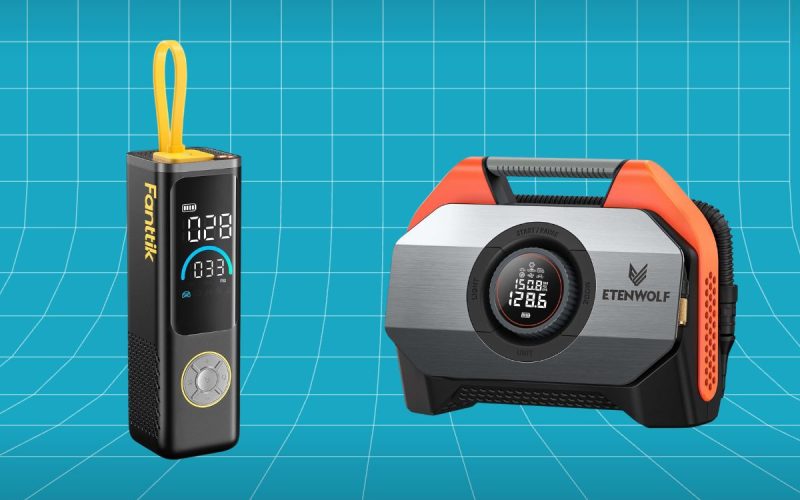
One to two pounds, battery powered, 120–160 PSI ratings. These handle sedans, SUVs, bikes and motorcycles without breaking a sweat, and they’re the only option that rides along for roadside emergencies. Compact units we’ve ranked, like the Fanttik X9 Pro, top off a compact-car tire in about a minute. The trade-off: modest airflow means big truck tires fill slowly, and cheap models can overheat on back-to-back tires.
Medium: Heavy-duty portable inflators (fits under a seat)
Three to six pounds, bigger motors, often dual-cylinder. This is the sweet spot for truck, SUV and trailer owners. The ETENWOLF VORTEX S6 we reviewed is the archetype: a 100% duty cycle dual-cylinder design built to run tire after tire without cool-down breaks — the failure point of smaller pumps. Still portable, still cordless, but with the stamina of shop gear.
Big: Pancake tank compressors (lives in the garage)
Twenty to thirty-five pounds, 110V wall power, 1–6 gallon tanks. A 6-gallon pancake like the Bostitch kit we’ve researched tops off four tires quickly once the tank charges, and — the real reason to buy one — runs nailers and blow guns. But it can’t leave the garage, it’s loud, and for tires alone it’s overkill by a wide margin. If you’re weighing this route, read our tire inflator vs air compressor breakdown first.
So — Big One or Small One? Match It to Your Situation
- Sedan or crossover, city driving: small handheld. Nothing more. Keep it charged and in the trunk.
- Pickup, full-size SUV, or you tow: medium heavy-duty portable. Higher-pressure LT tires and bigger air volume punish tiny pumps; duty cycle is the spec to watch, and we ranked the standouts in our best tire inflators for trucks and SUVs.
- Home workshop with air tools (or plans for them): the pancake compressor — plus, honestly, a small inflator for the road, since the tank unit can’t come with you.
- RV or trailer at 90–110 PSI: medium portable with a high-PSI rating and strong duty cycle. Gallons still don’t matter; sustained output does.
What About CFM and “Gallons Per Tire”?
CFM (cubic feet per minute) measures airflow, and it’s the spec tank-compressor marketing leans on. For tires it translates to speed, not capability: more CFM fills faster, but even 0.5 CFM eventually fills any passenger tire. Air tools are the genuine CFM applications — a topic covered well in the standard CFM reference if you enjoy the engineering. For inflation, don’t let a big CFM number talk you into a machine you’ll resent carrying.
Bottom Line
Tires need pressure, and every serious unit on the market delivers enough of it. Buy the smallest machine that matches your vehicles: handheld for cars, heavy-duty portable for trucks and RVs, and a tank compressor only when air tools enter the picture. Our full ranking of the best tire inflators sorts the market by exactly these use cases, so you can skip the gallon-counting entirely.
Related reviews
11.1V vs 14.8V Jump Starters: What Really Determines Starting Power?
Peak amps dominate jump starter advertising, but that headline number does not tell you how well a portable booster will…
Fanttik X9 APEX vs ETENWOLF VORTEX S6: Premium Tire Inflator Showdown
Fanttik X9 APEX vs ETENWOLF VORTEX S6: Premium Tire Inflator Showdown The Fanttik X9 APEX vs ETENWOLF VORTEX S6 matchup…
What PSI Should Car Tires Be? The Right Pressure for Every Vehicle
What PSI Should Car Tires Be? The Right Pressure for Every Vehicle What PSI should car tires be? For most…